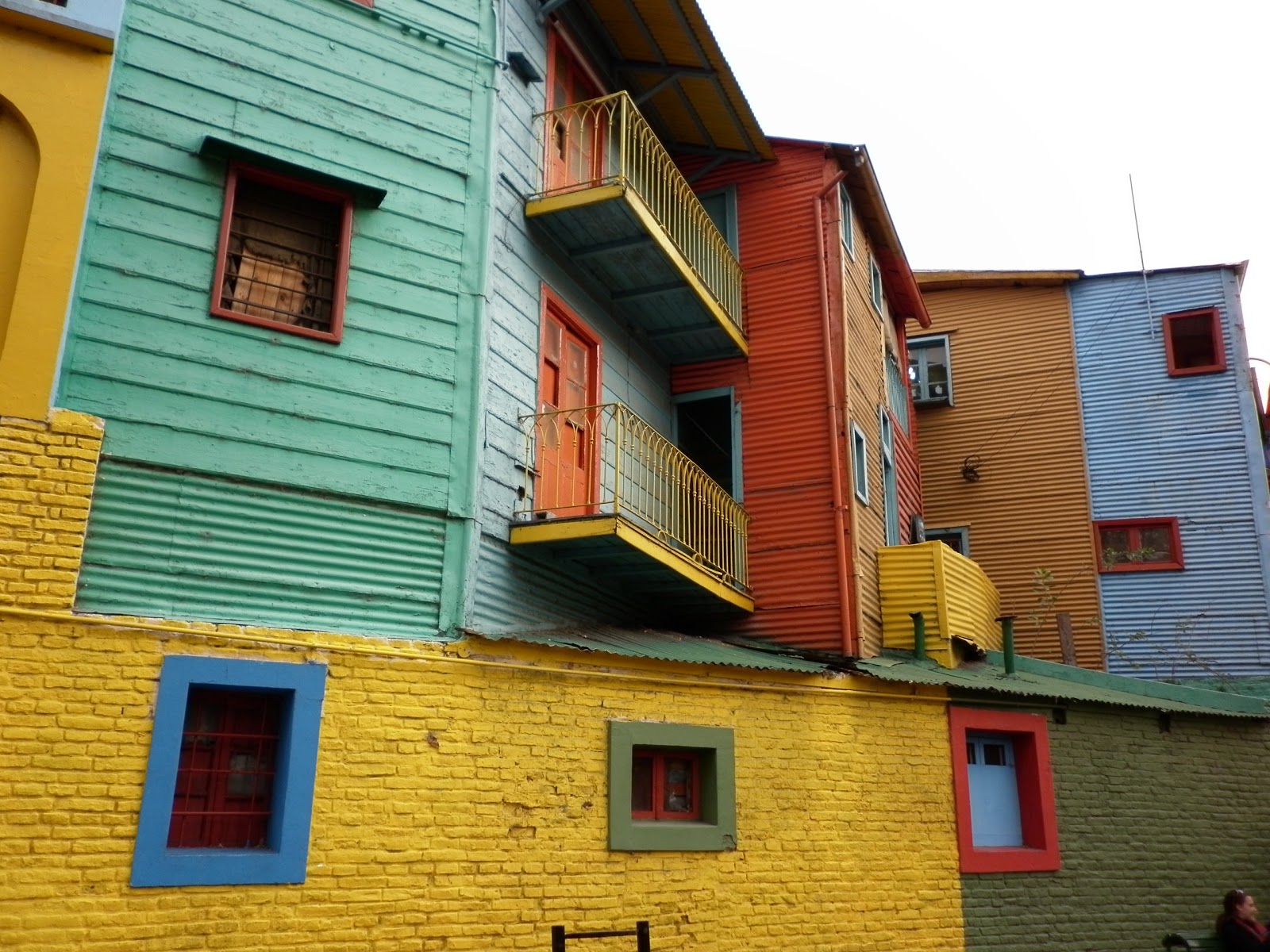
I left Rosario, in Uruguay, early on Thursday to get myself back to Buenos Aires. My flight home was on Sunday and I was looking forward to getting back to Argentina's capital for my final three nights on the continent.
The bus back to Colonia was easy enough, but when I arrived at the ferry terminal and tried to get through customs I was held back by the spotty 17 year-old at the desk.
He was asking for an 'embarkation card' - something I had apparently been given when I entered Uruguay just three days before.
By this stage I had crossed so many borders in and out of Argentina and Uruguay, I barely knew where I was - and what documentation related to what trip.
My passport had more stamps than a post office...

...and this embakation card was nowhere to be seen.
So I didn't have the paperwork and my catamaran was leaving in about 15 minutes. I asked to urgently see the customs manager and was greeted by a sharp-faced woman in an even sharper suit.
She explained what the boy had already explained: I needed this embarkation card to leave the country. Tell me something I don't know.
If I didn't have it I would have to stump up about £50. The boat itself had only cost £35 and - having spent six months on the road - I wasn't keen to start throwing away the little money I had left.
I pleaded sympathy with her and she barked something to me in Spanish before shrugging her shoulders and ordering the boy to stamp my boarding card. I fully expected to have to pay something once I reached the Argentinian side of the Rio Plata, but in the event I didn't. I got away with it.
So, drama averted and I was soon back in my old stamping ground of BA. I had enjoyed the city during my previous week's stay, but fancied a change of scene from the Milhouse. I booked myself into a hostel called America Del Sur in the San Telmo neighbourhood.
The America Del Sur was an impressive place. Five floors of immaculately designed rooms all hugging a central atrium:

It had good staff, clean bathrooms, nice mattresses and a comfy TV lounge. The only thing it didn't have was a lively atmosphere. I was entering the last weekend of my travels and was looking for a party, but I wouldn't be finding one at the hostel.
However, help was at hand just round the corner. Shaun, who I'd done the skydive with in Cordoba, was living in the city and he knew a guy (Clinton) that worked behind the bar in another hostel:

So each night we started there before doing the usual BA nightime activity: going clubbing in the early hours. I met various people in my last weekend, such as Daniel and Tiago from Brazil, and Martin from Germany:

On another night, Shaun and I went out for steaks down the road with a couple of girls we'd met at the hostel:


I loved that restaurant so much that I went back two nights in a row.
My one 'activity' that I had planned took place on Saturday. Now if you're already bored to tears of my posts about visiting the various Evertons in South America, you'd better go and find something better to do. Like watching paint dry.
After my visits to Vina del Mar and Rosario I had one more Everton to see, and they were based in La Plata - a city about an hour east of BA.
I had made contact with Everton La Plata after being given a contact from John, and found out that they would be playing a home match on Saturday at 3pm.
I stumbled out of bed at 11am, sleep-deprived and feeling like death, before jumping in a cab to Plaza Once to get a bus to La Plata. I got there just as one was about to leave, boarded and got my head down for an hour.
In La Plata it was approaching kick-off time, so I took a cab from the bus terminal in the direction of Everton's ground. The taxi driver (more of him later) warned me it was a fair way out of the city but I asked him to put his foot down and get me there asap.
We bombed it through the city streets towards the airport, near which Everton's ground was situated. City gave way to suburbia, suburbia gave way to fields. It was a long way and the meter kept on ticking over.
Eventually we got within a couple of blocks of the ground, and then we saw the ground, and then my heart sank. There was nobody there, it was 20 minutes until the supposed kick-off, and something was clearly up.
We pulled into the gravel drive and I got out and walked around the small changing room block. All the doors were closed and there was not a soul to be seen.


I tried to phone my contact, Marcelo, but had no signal. We were in the middle of nowhere and the game, if there was a game, was not happening here.
Damnit.
Not knowing what to do, I got back in the cab and asked the taxi driver to take me back to La Plata, to the HQ of Everton. On the way back I tried calling Marcelo several times - at one point stopping at a petrol station to use a payphone in case my mobile was playing up - but each time just got a broken dial tone.
The driver at this point seemed perplexed. What was this foreigner doing in La Plata, asking to be driven to far-flung places to see empty football pitches?
I started to explain to him in Spanish about how I was a hincha (fan) of Everton de Inglaterra and was visiting some of the other Evertons in South America. He immediately perked up and explained that he had once played in the Everton La Plata hockey team for seven years, and the club was close to his heart.
With a rapport building and no more deadlines to meet (I'd given up on the game at this point), he told me more about his life in La Plata. Halfway back to the city he surprised me by rifling through his bag and pulling out two cellophane-wrapped CDs.
It turned out he was Dany Osvald, a reasonably successful trumpet player (though not so successful that he could give up the taxi-driving day job...). He was - according to the blurb that came with the CD - El Trompetista:

He asked if I wanted to buy one, and of course I said yes. Buying a trumpet CD from an Argentinian taxi driver: there's a first time for everything.
We were soon back in central La Plata and he dropped me at Everton's headquarters:

I walked in to find a restaurant, a pilates class in full swing and various locked office doors. I asked a couple of people if they knew Marcelo, or anyone from the football side of the club, but had no joy.


But then I bumped into a woman who was managing the gym. I explained my visit and the non-event of the match. She phoned a couple of people, perhaps including Marcelo, and found out that the game had been suspended due to heavy overnight rain and a waterlogged pitch. Just my luck.
I was still glad I had made the journey to La Plata though. I spent a bit of time watching some men play a hybrid squash-type game in a massive hall out the back...

...and then headed off into the town centre.
It was the last game of the Argentinian league season and Gimnasia La Plata were playing Boca Juniors on the other side of the city. I'd missed kick-off because of my failed attempt to watch Everton, but caught a bit of it on TV and could hear the singing of the fans from the town centre.
I visited the disused ground of Estudiantes - one of Argentina's biggest clubs - and had a good walk round the city. Here are some pics:


I made it back to BA in the early evening and had one last, heavy night out with Shaun and the others. We started in Asia de Cuba down by the docks and ended up in a club in Palermo dancing to The Human League.
And that was my last night in South America. Sob.
I took a walk round the San Telmo antiques market on Sunday before getting a taxi to the airport. It felt very strange to be going home. Excited on the one hand, to see my family and friends, and sad on the other to be leaving such an incredible continent.
But home was calling me, and my sister's wedding in Italy. I checked in, had a bite to eat, got a final picture...

...and headed under a large sign that said Departures.
The bus back to Colonia was easy enough, but when I arrived at the ferry terminal and tried to get through customs I was held back by the spotty 17 year-old at the desk.
He was asking for an 'embarkation card' - something I had apparently been given when I entered Uruguay just three days before.
By this stage I had crossed so many borders in and out of Argentina and Uruguay, I barely knew where I was - and what documentation related to what trip.
My passport had more stamps than a post office...

...and this embakation card was nowhere to be seen.
So I didn't have the paperwork and my catamaran was leaving in about 15 minutes. I asked to urgently see the customs manager and was greeted by a sharp-faced woman in an even sharper suit.
She explained what the boy had already explained: I needed this embarkation card to leave the country. Tell me something I don't know.
If I didn't have it I would have to stump up about £50. The boat itself had only cost £35 and - having spent six months on the road - I wasn't keen to start throwing away the little money I had left.
I pleaded sympathy with her and she barked something to me in Spanish before shrugging her shoulders and ordering the boy to stamp my boarding card. I fully expected to have to pay something once I reached the Argentinian side of the Rio Plata, but in the event I didn't. I got away with it.
So, drama averted and I was soon back in my old stamping ground of BA. I had enjoyed the city during my previous week's stay, but fancied a change of scene from the Milhouse. I booked myself into a hostel called America Del Sur in the San Telmo neighbourhood.
The America Del Sur was an impressive place. Five floors of immaculately designed rooms all hugging a central atrium:

It had good staff, clean bathrooms, nice mattresses and a comfy TV lounge. The only thing it didn't have was a lively atmosphere. I was entering the last weekend of my travels and was looking for a party, but I wouldn't be finding one at the hostel.
However, help was at hand just round the corner. Shaun, who I'd done the skydive with in Cordoba, was living in the city and he knew a guy (Clinton) that worked behind the bar in another hostel:

So each night we started there before doing the usual BA nightime activity: going clubbing in the early hours. I met various people in my last weekend, such as Daniel and Tiago from Brazil, and Martin from Germany:

On another night, Shaun and I went out for steaks down the road with a couple of girls we'd met at the hostel:


I loved that restaurant so much that I went back two nights in a row.
My one 'activity' that I had planned took place on Saturday. Now if you're already bored to tears of my posts about visiting the various Evertons in South America, you'd better go and find something better to do. Like watching paint dry.
After my visits to Vina del Mar and Rosario I had one more Everton to see, and they were based in La Plata - a city about an hour east of BA.
I had made contact with Everton La Plata after being given a contact from John, and found out that they would be playing a home match on Saturday at 3pm.
I stumbled out of bed at 11am, sleep-deprived and feeling like death, before jumping in a cab to Plaza Once to get a bus to La Plata. I got there just as one was about to leave, boarded and got my head down for an hour.
In La Plata it was approaching kick-off time, so I took a cab from the bus terminal in the direction of Everton's ground. The taxi driver (more of him later) warned me it was a fair way out of the city but I asked him to put his foot down and get me there asap.
We bombed it through the city streets towards the airport, near which Everton's ground was situated. City gave way to suburbia, suburbia gave way to fields. It was a long way and the meter kept on ticking over.
Eventually we got within a couple of blocks of the ground, and then we saw the ground, and then my heart sank. There was nobody there, it was 20 minutes until the supposed kick-off, and something was clearly up.
We pulled into the gravel drive and I got out and walked around the small changing room block. All the doors were closed and there was not a soul to be seen.


I tried to phone my contact, Marcelo, but had no signal. We were in the middle of nowhere and the game, if there was a game, was not happening here.
Damnit.
Not knowing what to do, I got back in the cab and asked the taxi driver to take me back to La Plata, to the HQ of Everton. On the way back I tried calling Marcelo several times - at one point stopping at a petrol station to use a payphone in case my mobile was playing up - but each time just got a broken dial tone.
The driver at this point seemed perplexed. What was this foreigner doing in La Plata, asking to be driven to far-flung places to see empty football pitches?
I started to explain to him in Spanish about how I was a hincha (fan) of Everton de Inglaterra and was visiting some of the other Evertons in South America. He immediately perked up and explained that he had once played in the Everton La Plata hockey team for seven years, and the club was close to his heart.
With a rapport building and no more deadlines to meet (I'd given up on the game at this point), he told me more about his life in La Plata. Halfway back to the city he surprised me by rifling through his bag and pulling out two cellophane-wrapped CDs.
It turned out he was Dany Osvald, a reasonably successful trumpet player (though not so successful that he could give up the taxi-driving day job...). He was - according to the blurb that came with the CD - El Trompetista:

He asked if I wanted to buy one, and of course I said yes. Buying a trumpet CD from an Argentinian taxi driver: there's a first time for everything.
We were soon back in central La Plata and he dropped me at Everton's headquarters:

I walked in to find a restaurant, a pilates class in full swing and various locked office doors. I asked a couple of people if they knew Marcelo, or anyone from the football side of the club, but had no joy.


But then I bumped into a woman who was managing the gym. I explained my visit and the non-event of the match. She phoned a couple of people, perhaps including Marcelo, and found out that the game had been suspended due to heavy overnight rain and a waterlogged pitch. Just my luck.
I was still glad I had made the journey to La Plata though. I spent a bit of time watching some men play a hybrid squash-type game in a massive hall out the back...

...and then headed off into the town centre.
It was the last game of the Argentinian league season and Gimnasia La Plata were playing Boca Juniors on the other side of the city. I'd missed kick-off because of my failed attempt to watch Everton, but caught a bit of it on TV and could hear the singing of the fans from the town centre.
I visited the disused ground of Estudiantes - one of Argentina's biggest clubs - and had a good walk round the city. Here are some pics:


I made it back to BA in the early evening and had one last, heavy night out with Shaun and the others. We started in Asia de Cuba down by the docks and ended up in a club in Palermo dancing to The Human League.
And that was my last night in South America. Sob.
I took a walk round the San Telmo antiques market on Sunday before getting a taxi to the airport. It felt very strange to be going home. Excited on the one hand, to see my family and friends, and sad on the other to be leaving such an incredible continent.
But home was calling me, and my sister's wedding in Italy. I checked in, had a bite to eat, got a final picture...

...and headed under a large sign that said Departures.